Questo sito usa i cookie per fornirti un'esperienza migliore. Cliccando su "Accetta" saranno attivate tutte le categorie di cookie. Per decidere quali accettare, cliccare invece su "Personalizza". Per maggiori informazioni è possibile consultare la pagina .

Categorie
- Wargames e Miniature
- Achtung Panzer!
- Baueda
- Black Powder
- Bolt Action
- Flames of War
- Forged in Battle
- Games Workshop
- Gripping Beast & SAGA
- Hail Caesar
- Mirliton 15mm
- Pike and Shotte
- Star Wars Legion
- Team Yankee
- Wings of Glory
- Bandai Gundam
- Mortem et Gloriam
- Conquest Games
- Cyberpunk Red Miniatures
- D&D Miniature
- Fantasy Flight
- Fireforge Games
- Warhammer Age of Sigmar
- Infinity
- Italeri
- Osprey Publishing
- Para Bellum
- Perry Miniatures
- Plastic Soldier
- Victrix
- Wargames Atlantic
- Zvezda
- RuneWars
- Victory at Sea
- Cruel Seas
- Black Seas
- Muskets & Tomahawks
- Frostgrave
- Baron's War
- Footsore Miniatures
- Great War Miniatures
- North Star
- Crusader Miniatures
- Wargames Foundry
- Mirliton SG
- Kromlech
- Scenici Edifici e Terreni
- Oathmark
- Blood Red Skies
- Green Stuff World
- StarGrave
- Altar of the Dead Gods
- Trench Crusade
- Bandai Grand Ship Collection
- Avatar of War
- Blokees
- Rubicon Models
- Colori, Bombolette e Accessori Modellismo
- Outlet
Feedback nostri clienti
- 24.11.2026
Ottimo venditore serio e affidabile alla prossima
- 23.11.2026
Order delivered on time with no issues
- 23.11.2026
Order delivered on time with no issues
- 23.11.2026
Order delivered on time with no issues
- 23.11.2026
Order delivered on time with no issues

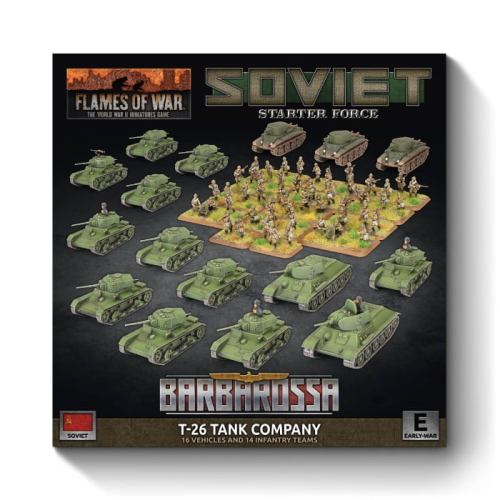
Flames of War Soviet Starter Force T-26 Tank Company
| Prezzo: | €110,00 Iva inclusa (22%) |
|---|---|
| Spese di trasporto: | A partire da € 10,00 Iva inclusa (22%)Maggiori dettagli |
| Cod. art.: | SUAB18 |
| Marca: | Battlefront |
| Produttore: | Maggiori dettagli |
| Disponibilità: | Disponibile |
| Quantità: |
Servizi
StampaFeedback degli utenti
Descrizione
SCALA 15mm (1:100)
prodotto da assemblare e da dipingere. Colori e colla non forniti.
The Red Army learned the value of tanks during the Russian Civil War of 1919 to 1921 when they faced them in the hands of the British, French, and White Russian Armies, and then used captured tanks against their former owners. After the war, Soviet industry took a decade to grow to the point where indigenous tank production was a serious prospect. However, once they started along the tank path, they moved much faster than the western powers. This rapid progress had three sources. The first was simply that there was less entrenched power structures to overcome - the Red Army was new and keen on modernisation. The second was the acquisition of foreign designs to kick start their own tank design. The third was the priority that tanks were given in the face of the perceived threat of a counter-revolutionary invasion and the need to spread the Communist revolution to the rest of the world.
With the will and the means to produce as many tanks as needed (at a time when the rest of the world was thinking in terms of a few dozen tanks to try things out), and their pick of the best tank designs in the world, it is not surprising that the Red Army led the world in the field of tanks in the 1930s. It was not only in the area of tank production that they led. The Red Army’s theorists developed a concept of deep operations bearing a lot of similarities to the German Blitzkrieg concept. These theories determined the types of tanks that would be needed.
LIGHT TANKS
The first thing required by the theorists was a breakthrough of the enemy front line. The idea was that massed light tanks would advance with the infantry, destroying enemy machine-gun nests and pinning down the enemy riflemen, allowing the infantry to capture the enemy trenches. This required a relatively cheap and simple design that could be fielded in large numbers. Fortunately, the Vickers-Armstrong company were offering exactly such a design with their 6-ton Type E tank.
T-26 OBR 1932
The Red Army bought some samples from Vickers and then proceeded to produce an unlicensed copy called the T-26. The first production model of 1932 (obr 1932) was a twin turreted
design with two side-by-side machine-gun turrets. While this seemed like a good idea at the time as it appeared to give the tank twice as much firepower, it quickly became
obvious that the difficulties in coordinating two turrets and a driver actually reduced its effectiveness.
T-26 OBR 1933
The second model (obr 1933) was more conventional with just a single turret mounting a 45mm gun and a coaxial machine-gun. The 45mm gun was one of the most powerful tank guns in the world at the time. The original Vickers design mounted a low-velocity 47mm gun (3 pdr). While this was effective against machine-gun nests, its anti-tank performance was woeful, especially compared with the Soviet gun that was used instead.
FLAME-THROWER TANKS
As well as conventional gun-armed tanks, the Soviet Union also created large numbers of flame-thrower tanks, nearly 10% of the entire production run. These KhT-26 and KhT-130 ‘chemical’ (hence ‘Kh’) tanks were fielded in full battalions to add even more punch to assaults on critical positions. As befitted its infantry support role, the T-26 was not much faster than an infantryman and its armour was bulletproof, but not much else. While not exactly desirable attributes, they did make it cheaper and easier to produce allowing the Soviet Union to manufacture over 10,000 of them — more than the total of all other armies’ tank production up to that point.
---
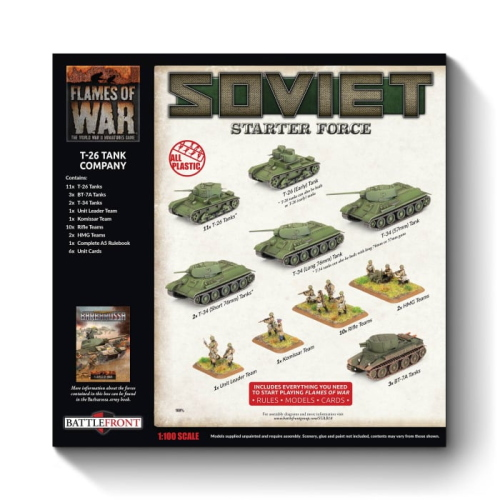
THIS PRODUCT CONTAINS:
11x T-26 Tanks
3x BT-7A Tanks
2x T-34 Tanks
1x Unit Leader Team
1x Komissar Team
10x Rifle Teams
2x HMG Teams
1x Complete A5 Rulebook
2x Decal Sheets
6x Unit Cards

